

Flourless Peanut, Chocolate and Caramel Cookies
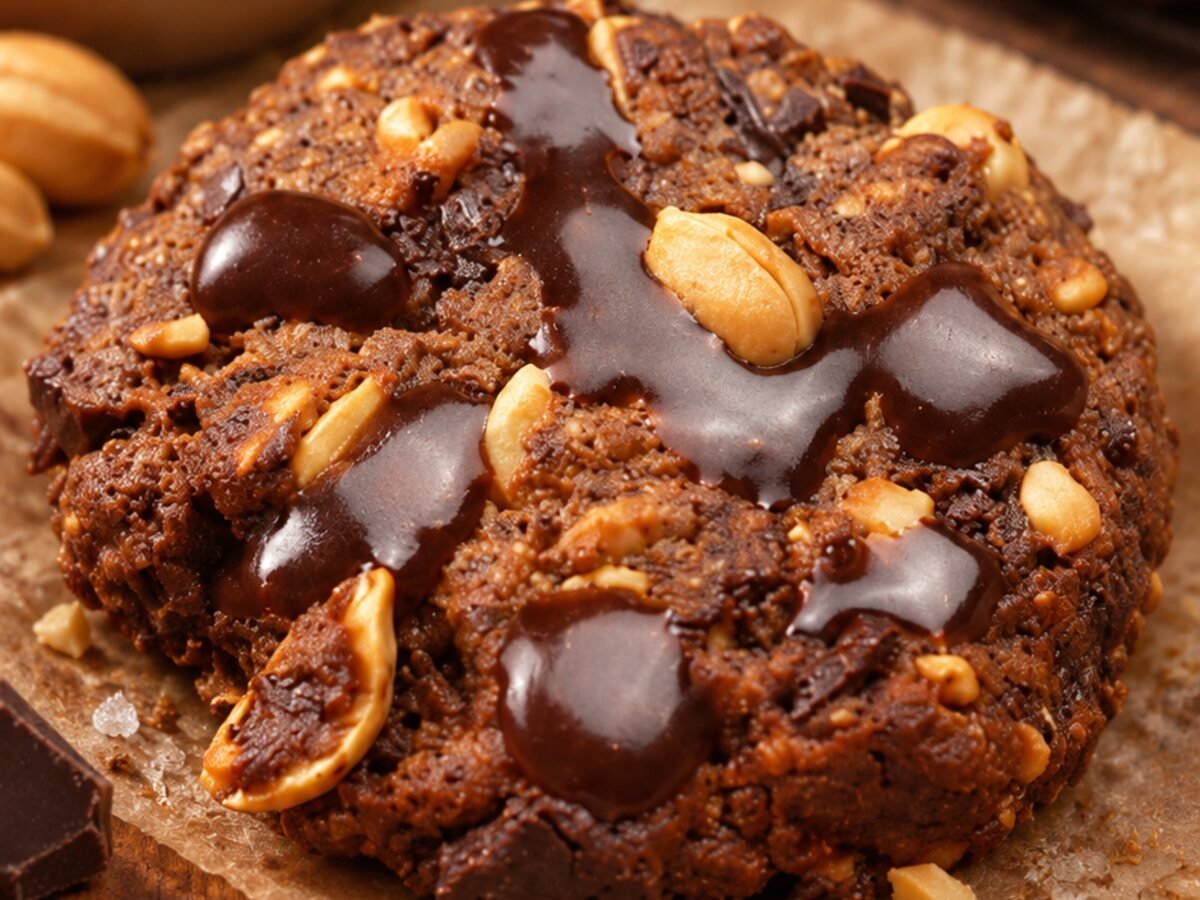
No flour, no eggs: peanut butter, whole peanuts, plenty of chocolate and a few dots of coconut sugar caramel.
The video for this recipe is coming soon.
Cookies without flour… and yet so very good.
I have a confession to make: the first time I came across flourless cookies on social media, I was frankly skeptical.
Cookies without flour? Really? How could you possibly get back everything that makes a real cookie so charming and so good, without using an ingredient that seems so indispensable?
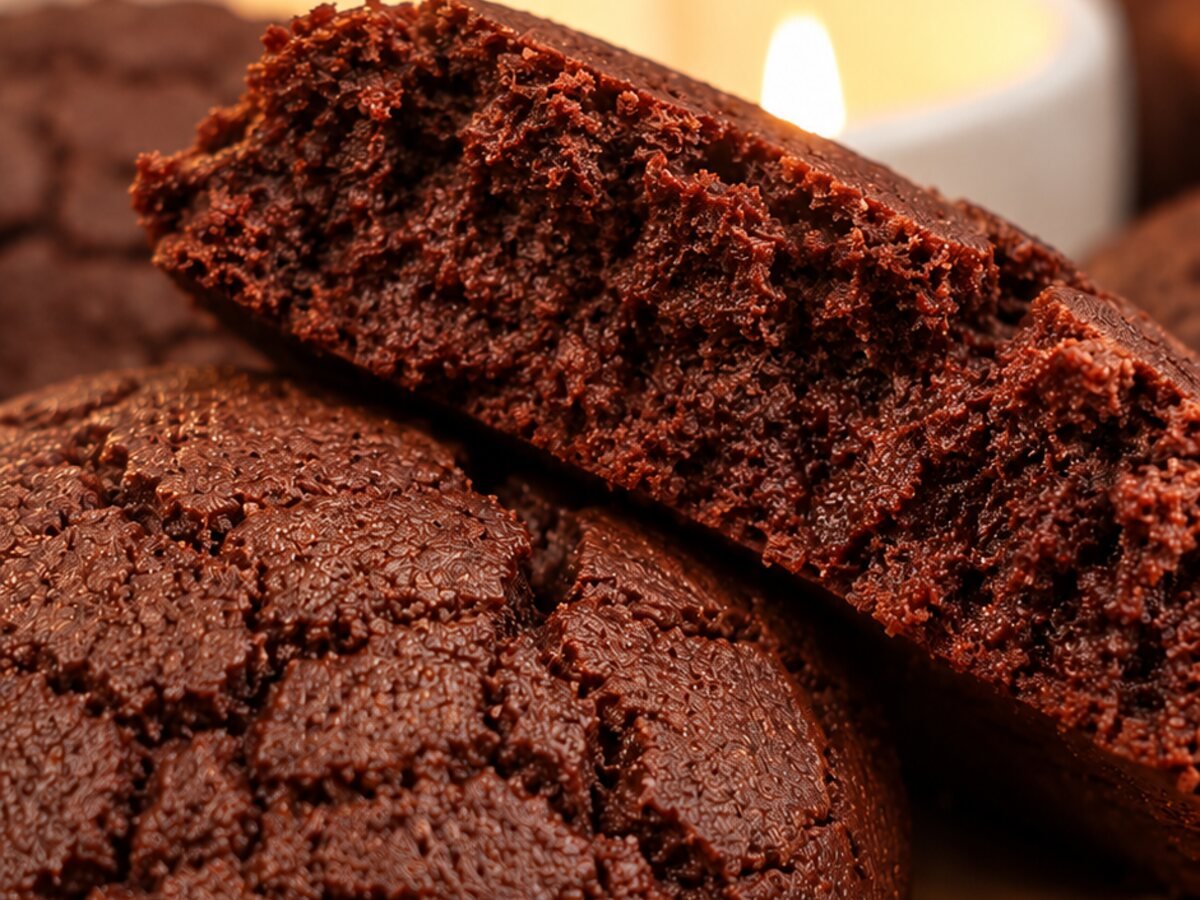
Because to me a good cookie has to respect certain rules: a generous, slightly irregular shape, deliciously crisp edges, a softer center, a good chew, melting chocolate and that lightly caramelized flavor that makes you want another one immediately. And of course that characteristic little contrast of textures, between the crisp outside and the tender inside.
I sincerely thought that taking out the flour would mean losing a large part of all that.
And yet… what an incredible surprise! Not only can these cookies have every one of those qualities, they also have something even more astonishing: a quite remarkable aromatic power. That is exactly what fascinated me.
The cookie, a small treat that became an institution
Did you know that the famous chocolate chip cookie, as we know it today, was born in the United States in the 1930s?
We owe its popularity to Ruth Wakefield, who ran the Toll House Inn in Massachusetts with her husband. Her recipe for cookies with chunks of chocolate, published in 1938, was to become a huge classic of American baking.
Ever since, the cookie has crossed borders, generations and culinary trends. It has appeared in countless versions, but its success still rests on that irresistible combination of textures, chocolate and indulgence.
And today we can even allow ourselves to rework its composition from the ground up, without giving up what makes it what it is. That is exactly what interests me in pastry: understanding the rules of a recipe so I can reinvent it, without ever losing the essential.
The magic of nuts: when flour becomes almost superfluous
What particularly won me over in these cookies is the extraordinary role nuts can play.
Peanuts, like hazelnuts or almonds, are naturally rich in fat, protein and flavor. Turned into a nut butter, they give the dough a texture and a richness that take over much of the role normally handled by flour and added fat.
It is quite fascinating to see that with a few simple ingredients you can get a cookie this good.
One clarification on the word "flourless," though: this recipe contains no flour at all, whether wheat, rice or any other grain. It does use a very small amount of cornstarch — only 10 g for eight cookies. Unlike corn flour, cornstarch consists essentially of starch. Here it contributes to how the cookies hold together and to their texture, without forming their base.
The bulk of their structure therefore rests on the peanut butter, the chia seeds and that small touch of starch.
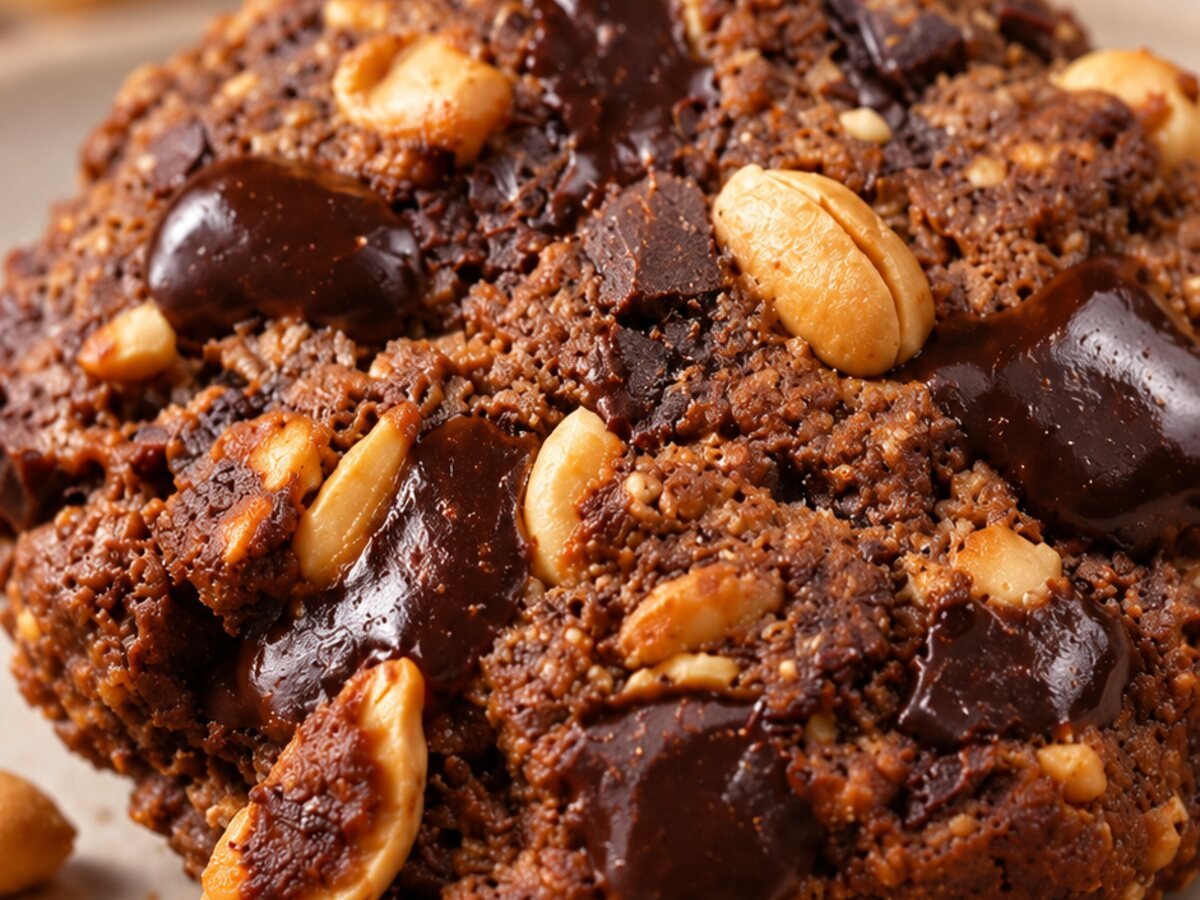
And there is another advantage I appreciate enormously: the flavor of the nuts is no longer diluted in a large quantity of flour. The peanut expresses itself fully, with all its depth and character. Paired with chocolate, it develops a particularly intense richness.
So this is not simply a cookie recipe with the flour taken out. It is another way of thinking about pastry, of working with textures and of putting the ingredients center stage.
My own version, gluten-free and 100% plant-based
As often happens when I discover a recipe that intrigues me, I wanted to experiment with it and adapt it in my own way. In particular I worked with chia seeds, which, once hydrated, form a natural gel that is useful for giving the dough cohesion without using eggs.
I also explored a hazelnut version, just as fascinating, with a very different aromatic personality. But today it is my peanut version that I want to share with you.
A generous recipe, rich in chocolate, with real whole peanuts for even more texture and indulgence.
And because I always like to add a personal touch to my desserts, after baking I placed a few small dots of my coconut sugar caramel on top — you will find that recipe on the blog too. This touch of caramel gives a lovely finish and an extra richness that pairs wonderfully with the peanut and the chocolate.
So if you too think a cookie without flour cannot really be a cookie, I invite you to try this recipe. You might be just as surprised as I was.
Total weight of the dough: 402 g, which comes to 50.25 g per cookie. Choose a chocolate suitable for a 100% plant-based diet and check the ingredient labels to make sure there is no gluten.
Ingredients
Makes 8 cookies, about 50 g each before baking, caramel not included
The dough
- 10 g chia seeds
- 40 g hot water
- 100 g peanut butter
- 40 g sugar of your choice (white sugar, coconut sugar, etc.)
- 2 g gluten-free baking powder
- 120 g dark chocolate, either as chips or a bar cut into chunks, as in my video
- 10 g cornstarch
- 80 g whole peanuts
To finish
- A few small dots of coconut sugar caramel
Method
- 1
Make the chia gel. In a small bowl, mix the 10 g of chia seeds with the 40 g of hot water. Stir thoroughly, then let stand a few minutes, long enough for the seeds to absorb the water and form a gel. This gel helps bind the ingredients and gives you a dough that holds together, without resorting to eggs.
- 2
Make the base of the dough. In a mixing bowl, put the peanut butter and the sugar you have chosen. Then add the chia gel and mix thoroughly until the mixture is smooth and even.
- 3
Add the dry ingredients and the mix-ins. Add the cornstarch and the gluten-free baking powder, then mix again to incorporate everything well. Finish by adding the chocolate chunks or chips, then the whole peanuts. Mix one last time so the mix-ins are evenly distributed through the dough. You end up with a generous dough, full of chocolate and peanuts.
- 4
Adjust the resting time to the room temperature. The consistency of this dough can vary with the temperature of your kitchen and the texture of your peanut butter. In summer, when it is warm, the dough may be softer and slightly sticky: in that case, refrigerate it for 15 to 30 minutes so it firms up and becomes easier to handle. If, on the other hand, your kitchen is around 18 to 20 °C (65 to 68 °F) and the dough does not stick excessively to your hands, you can usually go straight to shaping. The best indicator is the texture of your dough.
- 5
Shape the cookies. Preheat the oven to 170 °C (340 °F) and line a baking sheet with parchment paper. Divide the dough into 8 portions of about 50 g each, so the cookies come out an even size. Take a portion in your hands and start by pressing it gently, but firmly enough, so all the ingredients bind together. This is an important step in this recipe: unlike a traditional cookie dough, this mixture holds a great many chunks of chocolate and peanuts, and they need to be brought together for the whole thing to hold. So press the dough lightly between your two palms, then roll it into a nice compact little ball: all the ingredients should be properly bound and the ball should keep its shape. Place it on the sheet, then flatten it slightly with the palm of your hand to give it its cookie shape. Repeat with the remaining portions. Note one important peculiarity of this recipe: these cookies do not spread much during baking. So it is up to you to give them their shape and thickness before they go in.
- 6
Baking. Bake in the preheated oven at 170 °C (340 °F) for 15 to 20 minutes. The exact time will depend on the size and thickness of your cookies, and on your oven too. Watch the end of the bake: the cookies need to be baked enough to develop their structure and texture, without drying out.
- 7
Cooling and finishing. Out of the oven, let the cookies cool quietly on their baking sheet. This step matters: while they are still hot they are fragile. As they cool they firm up and develop their final texture. Once completely cool, transfer them carefully to a plate or an airtight container. For the greediest among us, add a few small dots of coconut sugar caramel on top, as I did. A little extra indulgence that makes all the difference.
My tips
- On the chocolate: personally, I very much like using a real bar of chocolate that I chop roughly with a knife. It gives you chunks of different sizes, some more generous than others, and that is particularly enjoyable to eat. But small chocolate chips work very well too.
- On the peanut butter: go for a plain peanut butter, ideally made of nothing but peanuts. Stir it thoroughly before use if the oil has separated.
- On shaping: take the time to press each portion of dough between your hands before forming your balls. This step binds the different ingredients and gives you cookies that hold together better. Do not forget to flatten them slightly before baking.
- On texture: above all, remember to let your cookies cool properly. The crispness develops, and is far more enjoyable, once the cookies are cool.
- On keeping them: store them for a few days in an airtight container, once completely cool. You can also keep them chilled, bearing in mind that the refrigerator can change their crispness.
- On planning ahead: if you do not want to bake them straight away, you can perfectly well put the sheet of shaped cookies in the refrigerator and bake a little later.
And now, over to you to discover this little marvel
I think this is also what excites me about plant-based, gluten-free pastry: realizing that ingredients we have known forever can hold extraordinary surprises.
Sometimes all it takes is changing how we look at them, stepping outside our habits and daring to experiment. These cookies are, to me, a very fine example.
No flour, no eggs, no dairy… but certainly not without indulgence.
And if you make this recipe, come and tell me how it went in the comments. I would love to know whether you were as surprised as I was by their texture and the intensity of their flavor.
See you very soon for more delicious discoveries.
Les Secrets d'une Cheffe
Emmanuelle Grillet-Aubert
Did you make this recipe?
Do share it on Instagram and tag me @lessecretsdunecheffe and use the hashtag below. I love seeing what you make.
#lessecretsdunecheffe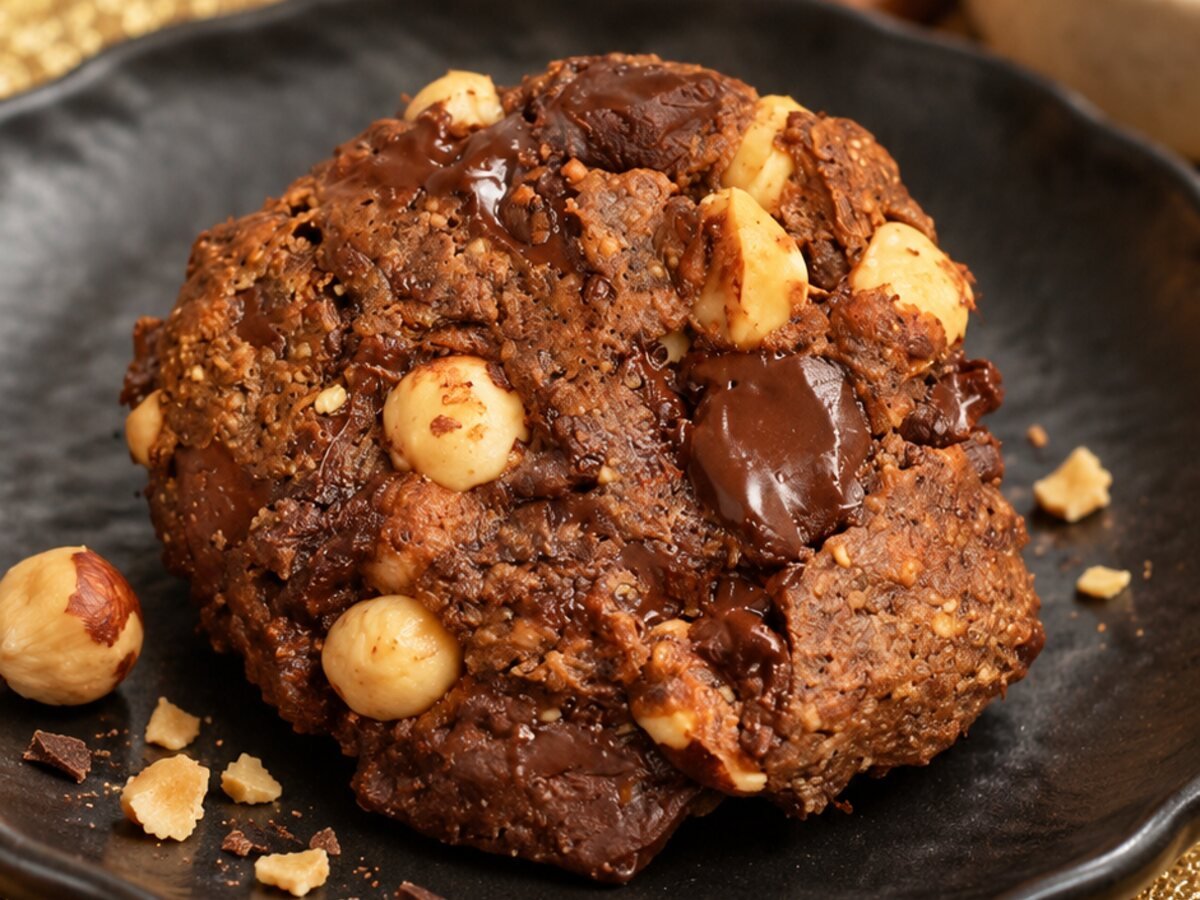
Want to go further?
The full courses take you through every move on video, with the recipe sheets and lifetime access.
Discover my video courses